FOR CLINICIANS And Researchers
Built from Science.
For Clinical Routine.
Spin-off of the Max Planck Institute for Molecular Genetics and Charité Berlin, founded in 2024 from the Mundlos lab. We build the intelligence layer for long-read genomics.

Why Lucid Genomics Exists.
Lack of end-to-end long-read native pipelines
The constraint in clinical genomics is no longer sequencing — it is interpretation.

Limited analysis of complex variants
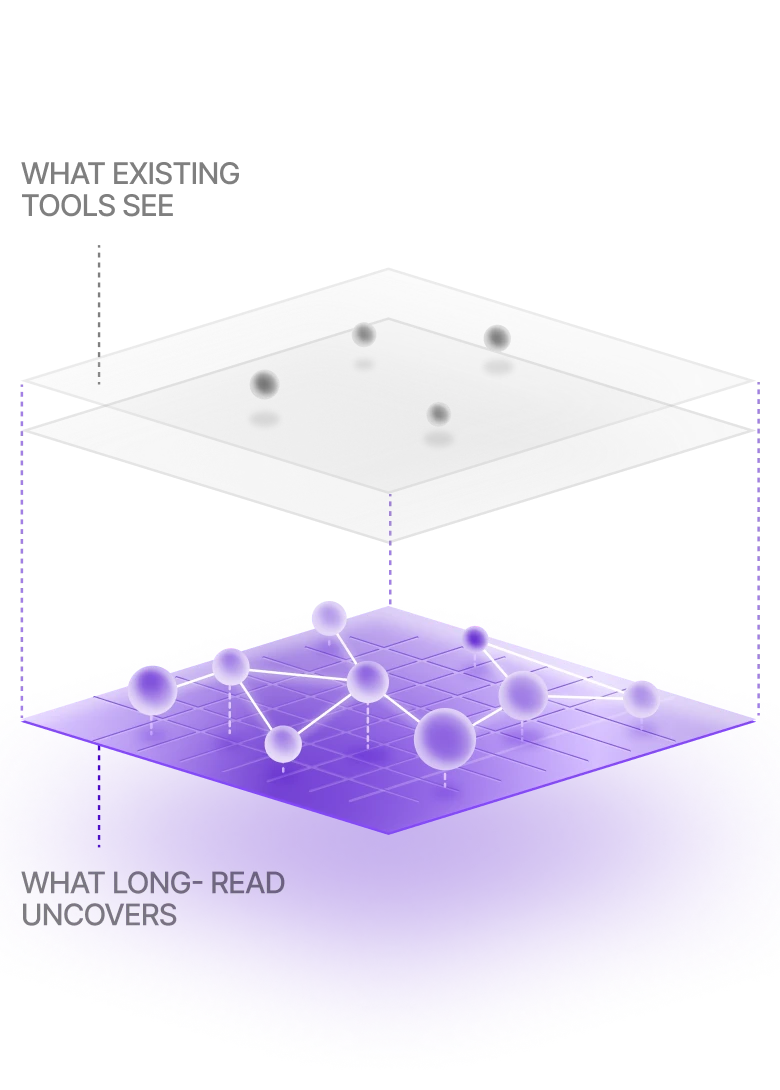
Structural variant that were missed by short-reads, now resolved by long-reads
Existing long-read tools only for RuO
Workflows — or short-read-first, not suitable for the data type that now matters.

We are building the leading
Long-Reads native platform
We believe that Long-read genomics deserves more than repurposed short-read tools. Lucid is developing a clinical grade interpretation layer tailored to capture the full potential of long-reads.
A Team of Scientists, Engineers, and Entrepreneurs
the founding team



Team





Scientific Advisors

Prof. Dr. Stefan Mundlos
Former Director of the Institute for Medical and Human Genetics at Charité

Prof. Dr. Martin Vingron
Director of the Max Planck Institute for Molecular Genetics
What this team understands.
Clinical Interpretation cannot be fully automated
Tools that try to automate the judgment step fail in clinical settings where final human confirmation is required
Long-read data has different statistical properties.
Pipelines designed for short reads produce systematically worse calls on long-read data and miss to unlock the potential
Compliance posture is architectural, not cosmetic.
Lucid complies to highest data security and privacy regulations under HPAA and GDPR
Diagnostic yield in rare disease is gated by SV detection.
Improving short-read SNV calling further is not where the next big diagnostic gain comes from.
Analyst trust is earned through transparency.
A platform that hides its reasoning will be tolerated for research and rejected for sign-out.
Methylation is the new frontier in diagnostics
Methylation comes with long-reads raw signals and can unlock new disease insights
Our Trusted Partners & Collaborators











Validation
What customers say.
Lucid is a spin-off of the Max Planck Institute for Molecular Genetics and Charité Berlin, built on the science of the Mundlos lab, one of Europe's leading rare-disease genomics groups.


Lucid Genomics' cohort analysis tool has been a game changer for our research. It’s intuitive yet powerful, allowing us to quickly compare patient groups and uncover key insights. The platform has streamlined our workflow and enabled faster, data-driven decisions.
Dr. Felix Boschann,
Medical Geneticist, Charité


Lucid cracked 30-year-old unsolved cases — revealing hidden variants and redefining how we see the genome. Simply one of the best tools to unlock the Dark Genome.
Prof. Pawel Stankiewicz,
M.D., Department of Molecular & Human Genetics at Baylor College of Medicine


Lucid integrates AI-driven algorithms allowing our team to quickly identify genetic variants and actionable insights with incredible precision. The intuitive interface and seamless collaboration tools have transformed how we analyze and share insights across teams.
Dr. Marco Saverese,
Principal Investigator, Folkhalsan Research Center
FIND YOUR SOLUTION
Cut through the noise.
Get to the answer.
Whether you're making diagnostic decisions or pushing the boundaries of discovery, Lucid meets you where the data gets complex.
Frequently Asked Questions
Is my data secure and GDPR-compliant?
Yes. Lucid runs on a GDPR-compliant AWS server in Frankfurt and adheres to the highest data privacy and security standards.
Is Lucid IVDR-certified?
We are currently preparing our IVDR submission and working closely with the relevant regulatory bodies throughout the process.
Can CLIA labs use Lucid?
Yes. Lucid supports your validation study to bring the platform onto your LDT (laboratory-developed test) program.
Do you support on-premise deployment?
Yes, on-premise deployment is possible. The specific requirements are discussed directly with our technical team to fit your infrastructure.
Does Lucid support long-read whole genome sequencing?
Yes. Lucid is purpose-built for long-read WGS analysis, covering SNVs, structural variants, repeat expansions, methylation, non-coding variants, and HPO-based prioritization.
Does Lucid support short-read genome sequencing?
Yes. Lucid supports short-read sequencing in addition to long-read WGS — and you can run mixed family analyses that combine short- and long-read data within the same case.
How do I get started?
We begin with a short intro call to understand your priorities, including a tailored demo and Q&A. From there, we offer a free trial where you can test the platform using public samples or your own in-house samples. Once you've seen it in action, we plan Phase 2: rolling Lucid into your workflow.